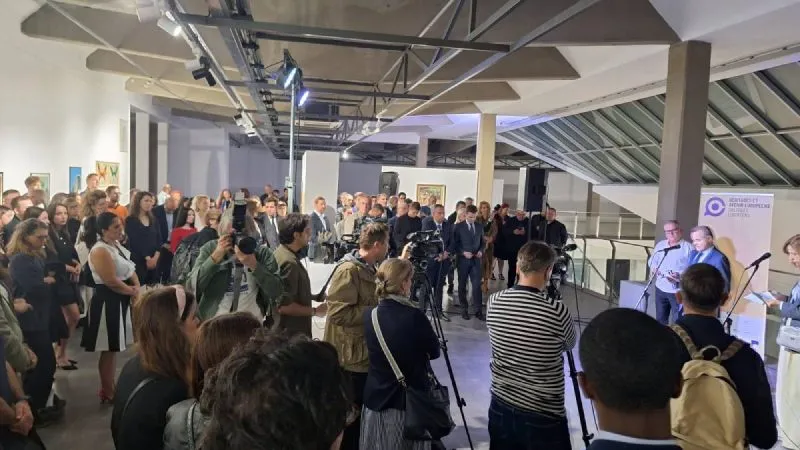
The new edition of “European Dialogues – European Heritage and Future”, organized by the French Institute and the Embassy of France in North Macedonia, opened in Skopje last night with the exhibition “Solidarity as the Future” at the Museum of Contemporary Art.
The events continue from today through 2 October at several venues across the city, including the Youth Cultural Center (MKC), Inox Center, the Jadro Cultural Center, Europe House and Laboratorium. The programme includes both closed working sessions and public debates on the relationship between history and politics, the legacy of anti-fascism, human rights, independent culture, disinformation and the future of European societies.
French Ambassador Christophe Le Rigoleur and Minister of Foreign Affairs and Foreign Trade Timcho Mucunski addressed the official opening. Le Rigoleur said that “Europe is not a finished project, but a collective construction,” stressing the importance of dialogue about Europe’s future.
“Within these dialogues, history is at the heart of our reflections, because we undoubtedly do not share the same readings of the past, nor the same historical memories. It is precisely this plurality of narratives that creates an obligation to discuss all these issues freely, but also with historical rigor, critical thinking and mutual respect.
“Europe is not based on erasing differences, but on our capacity to live together and to jointly build a common framework in which diversity can fully express itself. This common framework concretely reflects shared European values — dignity, freedom, equality, pluralism, democracy, protection of rights, freedom of expression and the possibility for everyone to find their place in society,” Ambassador Le Rigoleur said.

Mucunski said that EU accession should contribute to transforming society and strengthening institutions, rather than changing national identity. Addressing participants in the event, including young researchers and activists from EU and Western Balkan countries, he stressed that “the enlargement of the European Union is not only an investment in the stability of our region, but also a strategic investment in its own security, strength and future.”
The opening also featured the exhibition “Solidarity as the Future”, comprising a selection of significant works from the European collections of the Museum of Contemporary Art – Skopje, with particular emphasis on the collection created through international donations and artistic solidarity following the 1963 Skopje earthquake. The exhibition raises the question of how this historic act of solidarity can also be understood as a value for the present and the future.

The European Dialogues are part of the “Shared Horizons” programme, launched by France in 2024 with the aim of encouraging young people from the six Western Balkan countries to discuss their shared historical heritage and European future. The project is funded by the French Ministry for Europe and Foreign Affairs and includes activities related to youth mobility, the protection and promotion of heritage, combating disinformation and hate speech, and encouraging public debate.
Today’s programme is dedicated to history and shared heritage. The public debate “History as a Battlefield?” will begin at 6 p.m. at Inox Center, followed at 7:30 p.m. by a discussion on anti-fascism, democratic struggles, memory and ideological legacies.

On Thursday, discussions will focus on gender-based violence, LGBT+ movements in Europe and the future of the independent cultural scene.
Among the public debates is the panel “To what extent does the fight against disinformation restrict freedom of information?”, which will take place at Inox Center at 6 p.m., with representatives of the Metamorphosis Foundation, the French journal of opinions and ideas AOC (Analyse Opinion Critique) and the “Why Not” citizens’ association from Bosnia and Herzegovina.
The final day, 2 October, will focus on the future of Europe. The programme includes a roundtable titled “What Europe Do We Want Tomorrow?” and a European Youth Parliament dedicated to European values and the social, environmental, economic and cultural dimensions of Europe’s future. The programme concludes at Laboratorium with a Paris–Skopje musical dialogue.
The full programme, including information on which sessions are open to the public, is available on the website of the French Institute in Skopje.